
As I admire the company of a fresh monsoon breeze in my hair, surrounded by the rarity of peaceful silence and tranquillity, I am yet again tossed into a wave of retrospection. I begin to forge a deeper connection with a world that otherwise fades into the haste of our lives.
Hearing the cacophonous honking of trucks and altercations between two drivers, in an otherwise peace-filled afternoon, brings a faded memory of my early teenage to light. The memory of my curious observations during the much-loved evening walks with my grandfather. I remember, so clearly, the grimace on his face whenever we encountered such scenes of verbal aggression. He never enjoyed arguments or any form of noisy bickering. In the later years of his life, those walks, and the delightfully curious conversations they held, often ended with him narrating the same kind of stories: stories that on the surface informed me of the transitions in our city after the India-Pakistan partition but in truth spoke more deeply of his personal grief, pain, and a profoundly entrenched feeling of loss and remorse associated with the displacement.

One spring evening, we walked through the sports market of Jalandhar—the hallmark of my city, a place that supplies sporting equipment nationally and internationally, significantly boosting the local economy. My grandfather delved into nostalgia as he told me the tale of his uncle and fellow Hindu entrepreneurs moving across the border from Sialkot (now in Pakistan) along with their workers to Batala to re-establish the sporting industry, under the Government of India’s resettlement plan. However, after meticulous consideration, the industry was relocated to Jalandhar due to easy availability of raw materials such as leather.
I noticed a gleam in his eyes and a sudden shift to softness in his voice as a memory surfaced, a memory tied inextricably to this tale: summer afternoons spent with his cousins, running up and down the terrace stairs until the giggles echoed loud enough to annoy the neighbours during visits to his uncle’s house. They were absolutely unbothered by the scorching heat of the sun; children don’t care much for such obstructions as long as the frenzy continues. He said he missed the fun. The house. The streets. The city.
I loved watching television, even more so when I was younger. The integrated experience of voices and vivid animations astonished me! I would usually tune into music with my grandfather for he shared my love of syncing my heart to the rhythms until I could feel the same ecstatic spirit as the creator, transcend the boundaries of human-created barriers, and experience a feeling beyond our being. It was a feeling that he introduced me to.
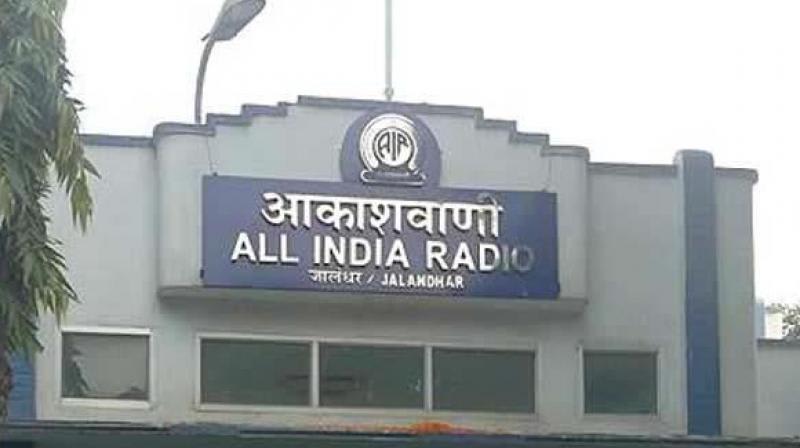
One evening, as we walked under the mesmerising violet sunset, we passed through Jalandhar’s All India Radio Station. A conversation struck as he joyously lived through his younger days with radio being the main source of entertainment. All of us know those stories: tweaking the antenna to catch the signal, a bunch of people gathered around to listen to the news commentary, waiting to hear that one beloved song! However, as I got to vicariously live through the time when Jalandhar’s AIR station was established, I was taken aback by the distress induced into the simplicity of people’s lives before its introduction. The reason? Before its introduction, Punjab’s AIR station was based in Lahore (now in Pakistan).
My curiosity piqued as I learned that from 1937 to 1947, Lahore’s AIR served as a central source of information and entertainment for people and continued to do so even post-partition, however, only for Pakistan. While the cities situated between Lahore and Amritsar were flooded with anxious refugees, their hearts pounding to an unsettled and unknown fate, there was no medium of communication to comfort the disoriented. No updates. No reassurance. No voice.
This was when Sardar Kartar Singh Duggal, one of the most accomplished icons of Punjabi literature who served as a senior officer at All India Radio Peshawar and later on at All India Radio Lahore, wrote an appeal to the interim government of India in New Delhi highlighting the urgent need for a radio station in East Punjab. The appeal was met with a positive response and high-powered transmitters were sent to Jalandhar, which was more centrally located and was acting as a stopgap administration centre of East Punjab at that time. Another transmitter was sent to Amritsar and the new combined radio entity came to be known as All India Radio Jalandhar-Amritsar. Its very first task: to repeatedly announce the names, villages, tehsils, and districts of missing individuals.
Our moods switched. The faces of starving children, mourning mothers, and desperate men from the refugee camp struck and swamped my grandfather’s mind. “The rehabilitation of lakhs of people,” he said quietly, “was one of the biggest challenges the government ever faced.”
“It was a horror. My brothers and I saw vultures simply sitting near the carcasses strewn on the ground. They were too full to eat,” he said.
Chills ran down my spine. I looked into his eyes, stunned. My heart sank.
For the first time in my life, I didn’t have the courage to ask any more questions.
About the Author

Suhana Sharma is deeply moved by the rhythms of human emotions. This curiosity fuels her fascination with the extraordinary spirit that pulses through the heart of India. She draws inspiration from the world around her, which continues to mesmerize her in quiet, powerful ways.


