
 We all have some idea of how, in ancient times, poetry was woven into expressions and sensorial experiences—through gaze, touch, smell, and more. These experiences often shaped the repertoire of paintings and became defining elements of ideologies, folklore, and belief systems. As we shift into a contemporary era increasingly reliant on artificially generated images, it becomes important to understand how text—its scenarios and expressions—serves as the foundation of meaning.
From this perspective, I turn my focus to photography as an artistic medium. Within it lies the enduring relationship between humans and nature, where gaze, gesture, and speech form a unique kind of poetry.
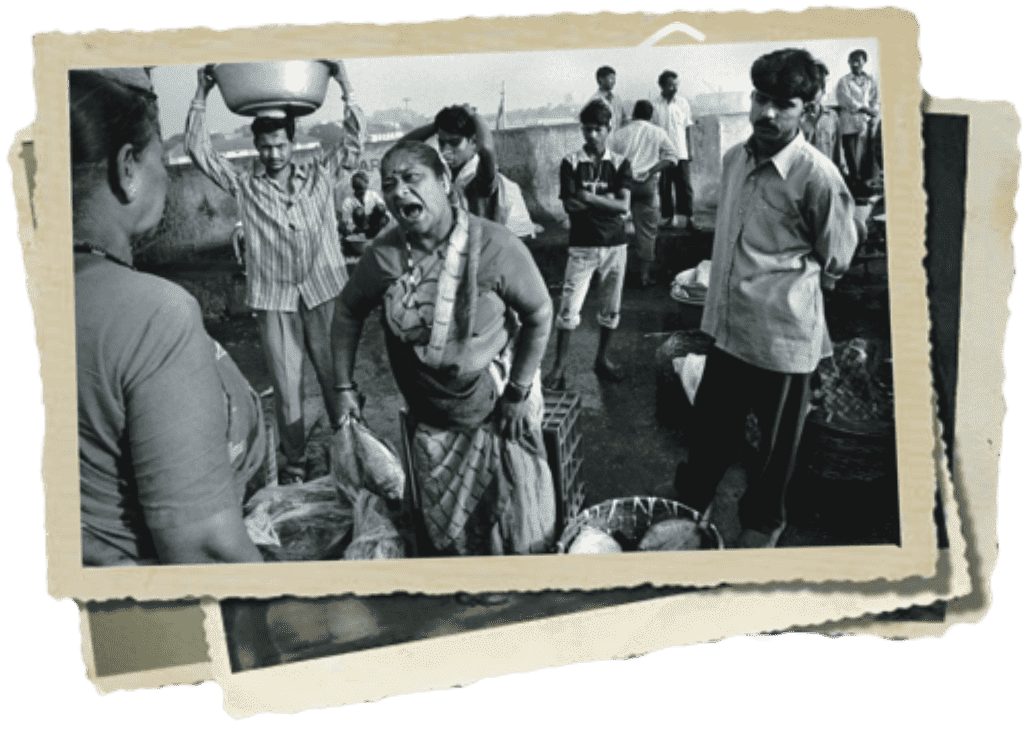
Markets, bazaars, souks: we’ve all visited them, perhaps fortnightly. For me, these spaces mark the starting point of the dialogue between art and poetry. I first encountered poetry in its simplest form within markets, through the phrases sung or shouted by vendors to attract buyers. While they may sound like high-pitched cries or even aggression, these expressions are vital — the vendor’s rhythm of survival.
For a silent spectator, observing these exchanges of words, hands, and eyes is a sensorial pleasure. It’s fascinating to witness how such gestures shape our livelihoods. In these chaotic yet patterned settings, observation becomes essential. While personal memories of these moments are fleeting and rarely shared in detail, photographs emerge as a powerful form of communication. They capture that essence of poetry — the unspoken intersection of daily life and deeper meaning.
In the photographs I feature, the body language, hand gestures, gaze, and speech between buyers, sellers, and even their surroundings form a compelling visual narrative. This everyday language — familiar, common — is rendered enticing. Sometimes, it convinces a buyer; other times, a disagreement arises. A rejected offer in the chaos of a marketplace can sting like a rejected love. The seller is hurt, the buyer might feel victorious, and the surrounding air — an invisible audience — absorbs the drama like a moment of catharsis.
In my recent visits to the market, I couldn’t help but notice how a fish seller uses his entire body to engage a buyer. The interaction borders on flirtation: subtle, playful, and strategic. As an observer, I found myself smiling, as if in on a secret shared between seasoned buyer and seller. The fluttering hands, pointed fingers, rising bellies with laughter, nodding heads, intense eye contact, impassioned bargaining, or frustrated demands — each moment is a performance, a revelation of personal choice.
If, amid negotiation, a seller decides to walk away, the mood shifts. The once-live atmosphere becomes heavy with silence, the unresolved tension lingering in the air.

Stillness, too, is part of this world. It’s something we all encounter — those moments of doing nothing but existing. Picture a vendor sitting quietly, at ease with their wares, observing the market as if seeing it anew. In that stillness, they resemble a photographer, absorbing the scene, composing it internally. They may not hold a camera, but their mind captures the image just the same.
If a florist naps beside their blooms, open to the gaze, touch, or even theft of passersby, what does a photograph of that moment signify? Perhaps it speaks of surrender, of peace reclaimed amidst the chaos, or of a silent trust in the world around them.
Photographs, in this context, preserve the subtleties of everyday market life. They document the smallest of actions — the unnoticed, the familiar. While we often reach for our cameras to capture novelty or rarity, we tend to overlook the beauty of routine. Through routine and history, we’ve all contributed to the act of documenting life, whether through developed film, photo albums, digital cameras, phone galleries, or Polaroids. Photographs become a record of the visual language of unspoken words.

To most of us, photographs of a bustling market, a buyer and seller deep in conversation, or a deserted shop may not feel personal. They may seem abstract, detached from context. But every presence in the market carries with it a cultural and demographic story — people enriched by a particular craft or trade. In this way, the market or bazaar becomes more than a space; it becomes a symbol of livelihood and society. Through these interactions, we become interdependent. Our personal histories merge with public surroundings.
If our keepsakes narrate the poetry within the four walls of our homes, then the narrow, crowded roads filled with wares and sounds become poetry for the external world. In capturing these fleeting moments, photography resists the urge to divide the structured from the spontaneous.

Photographs capture the intersection where art meets poetry. In the everyday rhythm of markets and bazaars, each transaction unfolds like a poetic performance, shaped by gestures, gazes, and body language that speak a language of their own.
Author’s Note:
Sharon Ann Sam
Sharon is an aspiring art historian, currently pursuing her postgraduate studies in Art History and Visual Studies at the University of Hyderabad. She often finds herself caught between words and visuals, thought and feeling. Most days, she finds comfort in music, quiet libraries, and the familiar warmth of a good cup of coffee.


