
The train chugged sleepily into Jhansi Station, but I was wide awake and excited to begin my Madhya Pradesh adventure! Whilst Jhansi Fort promised to live up to its expectations, it was Orchha that I was intrigued about. A UNESCO World Heritage city, and I, the history buff, a match made in heaven!
Having dumped our luggage at the hotel, I was raring to go… luckily, everything was pretty central and I felt as if I had stepped back in time. The city was quaint and rustic, and walking around this ancient temple town transported me back to what life must have been like during that period.
This 15th-century city was established by Rudra Pratap Singh and thrived till the Mughals captured it. It is interesting to note that the kingdom of Orchha was bestowed upon Vir Singh Deo, a Bundela king, by the then Mughal monarch Jahangir, in recognition of his assistance in fighting Jahangir’s enemies. Under the Bundela rule, Orchha flourished! While mentioning Jahangir, what remained with me was what our guide mentioned about the Jahangir Mahal, which is within the Orchha Fort Complex. The guide said that the palace was built exclusively to host Emperor Jahangir and to showcase the friendship between the two rulers. It is another thing that he stayed there only one night! The palace is crowned with eight Timurid-style domes with smaller domes in between them. Remnants of the turquoise tiles are still visible in some parts of the domes and roofs. The windows of the palace have the beautiful jaali or lattice work, reminiscent of Mughal times.

A part of the Orchha Fort complex is the Raja Mahal. The external facade is austere, almost deceiving with its simplicity, but within its stone walls lies grandeur: Marvellous murals that whisper tales of a grand epic. Walking from one chamber to the next is like walking in a trance. The Raja Mahal exemplifies Bundela architecture, Rajput elegance and Mughal flair. Latticed windows, arched corridors and domed pavilions overlook the Betwa River.
Adjacent to the Raja Mahal is the Sheesh Mahal, as the name implies, the palace of mirrors and light. Though time may have faded much of its original splendour, remnants of mirror work and glass still glimmer, catching an occasional stray beam of sunlight. The Sheesh Mahal overall feels more intimate than the formal Raja Mahal. Though now a heritage hotel, the ghost of the past lingers in every nook and cranny.
Each step taken in Orchha is a step in history. You are surrounded by mystique and royalty. Here, time stands still amidst the remnants of Bundela glory. Other noteworthy mentions: Raja Mahal, Sheesh Mahal ( within the Orchha Fort Complex), the Ram Raja Temple, the Laxmi-Narayan Temple and the Chaturbhuj Temple.
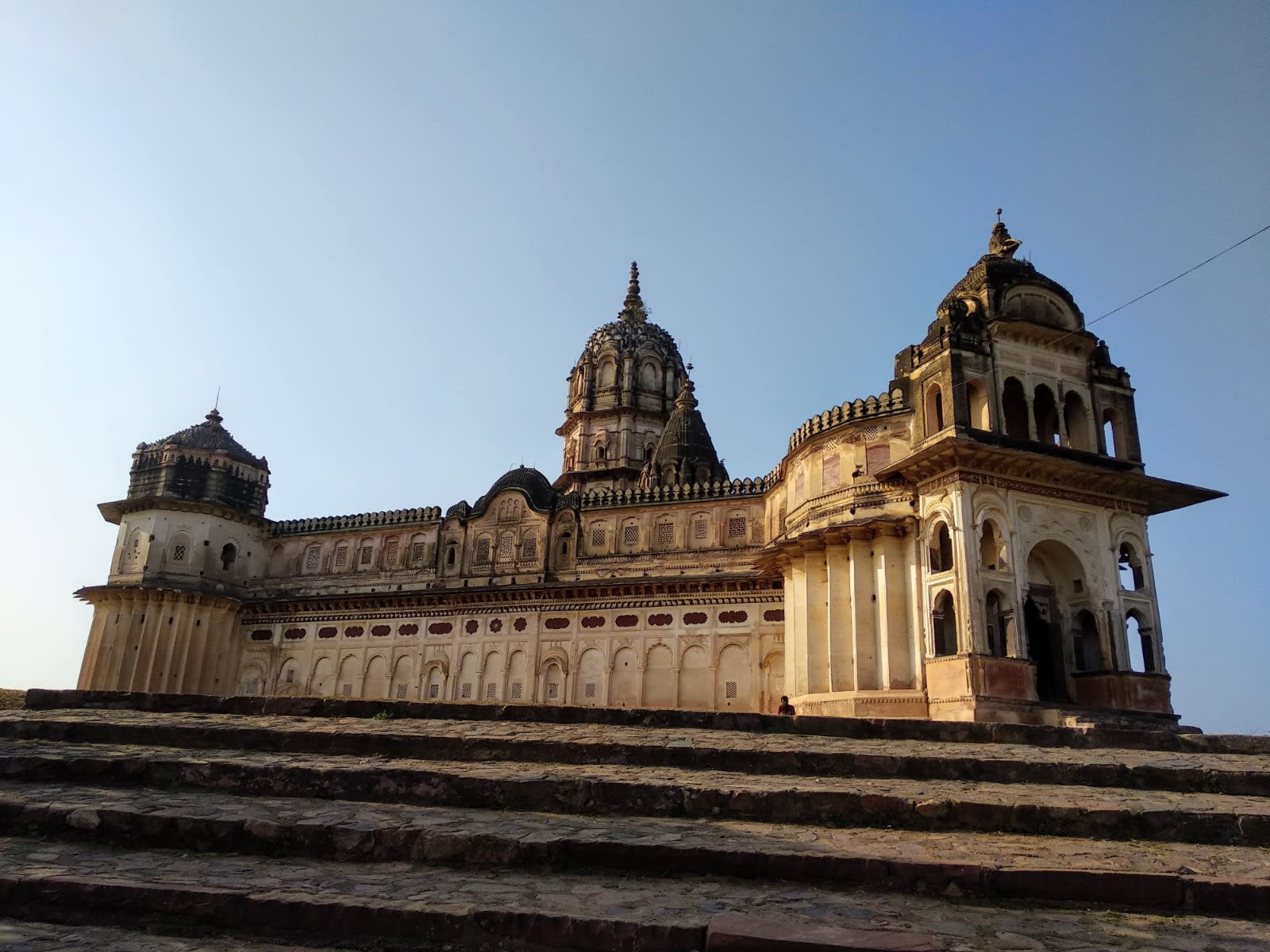
The Chaturbhuj temple itself is a marvel of medieval engineering, and its tall spires seem almost to reach for the sky. It is a Hindu temple with the tallest Vimana ( ornate monumental tower). The name ‘Chaturbhuj’ means four-armed, and it is dedicated to Lord Vishnu. It was originally built to house the idol of Lord Rama( now in the Ram Raja Temple) and designed to resemble a lofty shrine with massive stone towers, the tallest spire being almost 344 feet. The interiors are huge and cavernous, a dramatic contrast to intricately carved contemporary shrines. The temple corridors’ vertical pointed arches remind us of the Gothic cathedrals of Europe, though the detailing is essentially Bundela: floral arabesques, lotus motifs and niches for idols. The view from the top is breathtaking for those brave enough to climb the steep staircase.

The Ram Raja Temple mentioned above is the only temple in India where Ram is worshipped as a king, replete with royal protocols, making it unique. The myth behind this is that the structure was once the palace of Maharani Kamla Devi, the queen of Orchha. She bought the idol from Ayodhya, intending to install it in the nearby Chaturbhuj Temple. However, the idol refused to budge from her palace, hence transforming it into a temple. While the architecture is simple, the treatment is royal. Lord Rama is offered royal meals while guards stand to attention, and people queue up waiting for their turn to see their king and God.

The Laxmi Narayan Temple, sitting solitary on a rocky hilltop, is another stunning piece of architecture. Gazing at it from a distance, it looks regal and sturdy, much like a fort. This hybrid of temple and fortress architecture is recognised for its high walls, angular bastions and fantastic views of the plains around it. If the local guide had not mentioned it to us, we might have mistaken it for a fortress. He also asked us to notice that the entire structure seems like an owl in flight. What makes it even more interesting is that Goddess Lakshmi’s vahan ( vehicle) is the Owl. The temple is renowned for its stunning frescoes and murals, which depict a blend of religious, mythological, and daily life.
No visit to Orchha is complete without visiting the ‘Chattris’ or cenotaphs( tombs). The Chattris make a captivating sight by the banks of the River Betwa. There are fourteen of these palatial funerary monuments. What makes these Chattris unique is that each one is topped with a temple-style shikhara. The cenotaphs reflect an eclectic mix of Bundela and Mughal architecture, whilst they differ in design and size, they share key elements. Square or octagonal bases, multi-tiered pavilions with latticed windows, ornamental domed umbrellas perched on the roof, beautiful arches that frame the river or nearby temples. They stand as sentinels of the once-mighty Bundela dynasty. There is an aura of peace and serenity, and just sitting there is enough for time-travel. If you sit there long enough, you will also notice vultures on the spires of the cenotaphs. We were told they are a rare Indian species. The Chhatris truly are poems in stone.

Orchha was our first stop in the glorious golden crown that is Madhya Pradesh, a land where every stone whispers history and mystery. Our travels took us to Khajuraho’s temples, where passion is carved in stone, the serene stupas of Sanchi echoing with chants of a forgotten era, the much-filmed dramatic Marble Rocks of Jabalpur, where the Narmada River meanders through white chiselled cliffs. The untamed beauty of Raneh Falls and the ancient caves of Udaygiri and Bhimbetka, where prehistoric art is frozen in time.
Yet, it was Orchha that stole our hearts. Call it mystical that Orchha means ‘hidden’, for it remains a place veiled from the typical tourist trail. Orchha isn’t a destination; it’s a sensory experience! A visual treat of temples, forts, cenotaphs, murals and palaces. Orchha, with its hidden charm unfolding slowly like a secret shared only with those who take the time to listen, enveloped us in its magic.
In the golden crown of Madhya Pradesh, Orchha remains its most precious jewel, unpolished and humble but luminous beyond compare.
About the Author :

Karishma Agarwal is a multifaceted individual whose passion for history, mythology, and ancient monuments is deeply ingrained in both her personal and professional pursuits. As an avid reader and artist, she draws inspiration from the rich tapestry of stories woven through the ages.
Karishma’s role allows her to combine her love for storytelling with her expertise in historical and mythological narratives.


